
Home >> Shape & Space - Transformations
Coursework Notes - Shape & Space
points |
Translation of points
A point (x,y) can be moved to another position by applying a column matrix vector.
A column matrix vector is just two numbers, one above the other, surrounded by long brackets. The top number adds to the x-coordinate while the bottom number adds to the y-coordinate.
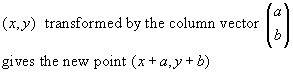
Example
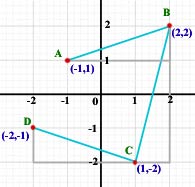
move right or left = x more positive or more negative
move up or down = y more positive or more negative
A(-1,1) to B(2,2) by going to the right 3 and up 1 by applying vector 
B(2,2) to C(1,-2) by going to the left 1 and down 4 by applying vector 
C(1,-2) to D(-2,-1) by going to the left 3 and up 1 by applying vector 
Translation of shapes
This is similar to the translation of a point except that the vector column matrix is applied to each point of the shape in turn to move the whole shape to another position.
example Translate the triangle ABC by the vector column matrix 
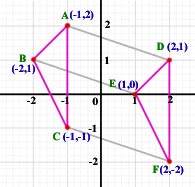
Each x-coordinate is increased by 3 (moved right 3)
Each y-coordinate is reduced by 1 (moved down 1)
Reflections
A reflection is a mirror image of the shape about an arbitrary line. This line can be for example x=0(y-axis), y=3, y=x(diagonal) etc.
Reflected points can be located by remembering that:
each point is as far infront of the line as the image of the point is behind
So measure the perpendicular distance of each point on the shape from the mirror line, then measure each distance the other side of the line to locate the points.
Example Draw the reflection of triangle ABC in the y-axis.
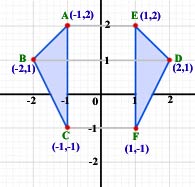
Point A is 1 unit infront of the y-axis mirror.
Therefore the reflected point(E) is 1 unit the other side of the line.
Similarly, B is 2 units infront. D is 2 units behind. C is 1 unit infront. F is 1 unit behind.
Method for locating mirror images
|
Rotations
In order to rotate a shape, 3 pieces of information are required:
the centre of rotation - the direction of rotation - the angle of rotation
Example - Rotate triangle ABC through 60 deg. in a clockwise direction about point P.
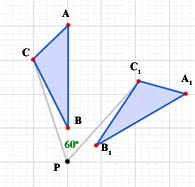
method
|
Enlargements
In order to enlarge a shape, 2 pieces of information are required:
the centre of enlargement & the scale factor
Example Enlarge triangle ABC by a scale factor of 1.5 form the point P.
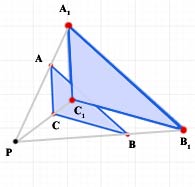
method
|
[ About ] [ FAQ ] [ Links ] [ Terms & Conditions ] [ Privacy ] [ Site Map ] [ Contact ]