
Home >> Algebra - Inequalities
Coursework Notes - Algebra
symbols |
||
Symbols
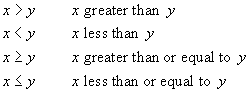
The rules of inequalities
These are the same as for equations i.e that whatever you do to one side of the equation(add/subtract, multiply/divide by quantities) you must do to the other.
However, their are two exceptions to these rules.
When you multiply each side by a negative quantity
'<' becomes '>' or '>' becomes '<'
That is, the inequality sign is reversed.
Similarly, when you divide each side by a negative quantity
< becomes > or > becomes < .
As before, the inequality sign is reversed.
Examples
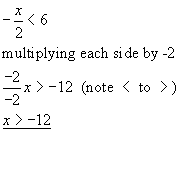

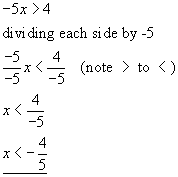
Inequalities with one variable
Example #1 - Find all the integral values of x where,

The values of x lie equal to and less than 6 but greater than -5, but not equal to it.
The integral(whole numbers + or - or zero) values of x are therefore:
6, 5, 4, 3, 2, 1, 0, -1, -2, -3, -4
Example #2 - What is the range of values of x where,

Since the square root of 144 is +12 or -12(remember two negatives multiplied make a positive), x can be equal to 12 or higher , or x can be equal to -12 or less.

Inequalities with two variables - Solution is by arranging the equation into the form
Ax + By = C
Then, above the line of the equation,
Ax + By < C
and below the line,
Ax + By > C
Consider the graph of -2x + y = -2
note - The first term A must be made positive by multiplying the whole equation by -1.
The equation -2x + y = -2 becomes 2x - y =2 .
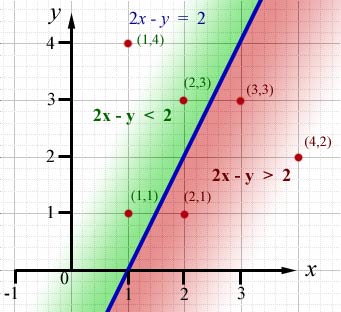
Look at the points(red) and the value of 2x - y at each point.
The table below summarises the result.
|
point(x,y) |
2x - y |
value |
more than 2 ? |
above/below curve |
(1,1) |
2(1)-(1) |
1 |
no - less |
above |
(1,4) |
2(1)-(4) |
-2 |
no - less |
above |
(2,3) |
2(2)-(3) |
1 |
no - less |
above |
(3,3) |
2(3)-(3) |
3 |
yes - more |
below |
(2,1) |
2(2)-(1) |
3 |
yes - more |
below |
(4,2) |
2(4)-(2) |
6 |
yes - more |
below |
[ About ] [ FAQ ] [ Links ] [ Terms & Conditions ] [ Privacy ] [ Site Map ] [ Contact ]