
Home >> Shape & Space - Circles
Coursework Notes - Shape & Space
parts |
The parts of a circle
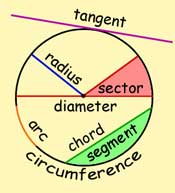
centre - the point within the circle where the distance to points on the circumference is the same.
radius - the distance from the centre to any point on the circle. The diameter is twice the radius.
circumference(perimeter) - the distance around a circle.
chord is a straight line joining two points on the circumference.
diameter - a chord(of max. length) passing through the centre
sector - a region enclosed by two radii and an arc.
segment - the region enclosed by a chord and an arc of the circle.
tangent - a straight line making contact at one point on the circumference, such that the radius from the centre is at right angles to the line.
Subtended angles
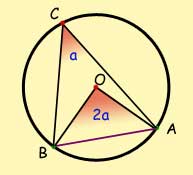
When a chord subtends an angle on the circumference of a circle, the angle subtended at the centre of the circle is twice the angle.
A diameter subtends a right-angle at the circumference.
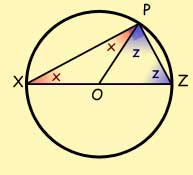
angle XPZ = 90 deg.
Angles subtended by a chord onto the circumference of a circle are equal.
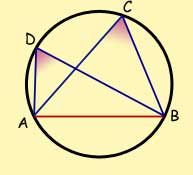
angle ADB = angle ACB
Chords
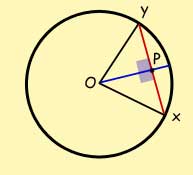
The line joining the centre of a circle and the mid-point of a chord is perpendicular to the chord.
The chord is bisected into two equal halves.
XP = PY
Tangents
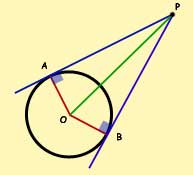
The tangents to a circle from a point are equal in length.
AP = BP
also,
the tangents subtend equal angles at the centre of the circle
angle POA = angle POB
and,
the angles between the tangents and the line joining the centre of the circle and the point are equal.
angle APO = angle BPO
note : Triangle APO and triangle BPO are congruent.
The angle between a tangent and a chord
The angle between a tangent and a chord is equal to the angle subtended by the chord in the opposite segment.
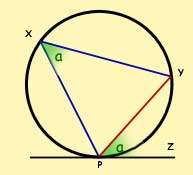
angle ZPY = angle PXY
Cyclic quadrilaterals
Opposite angles in a cyclic quadrilateral add up to 180 deg.
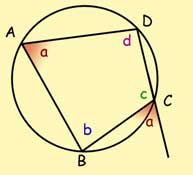
As with all quadrilaterals, the sum of the interior angles = 360 deg.
Any exterior angle of a cyclic quadrilateral equals the interior opposite angle.
[ About ] [ FAQ ] [ Links ] [ Terms & Conditions ] [ Privacy ] [ Site Map ] [ Contact ]